
A new financial year has arrived, and with it, a fresh set of income tax rules that could meaningfully change how much you actually owe the government — or keep in your pocket. The Income Tax Rules, 2026, effective April 1, 2026, introduce a range of structural changes for salaried individuals. These rules work alongside the Income Tax Act, 2025 and apply to Tax Year 2026-27. Note that ITR filing for this year is due by July 31, 2027.
Here’s the critical nuance: the tax slabs haven’t changed. What has changed is how much of your income qualifies as taxable in the first place. In other words, salary taxation is now more structure-driven than rate-driven. If your salary components are optimally arranged, your taxable income can shrink significantly — and so can your tax bill.
What’s New Under Income Tax Rules, 2026?
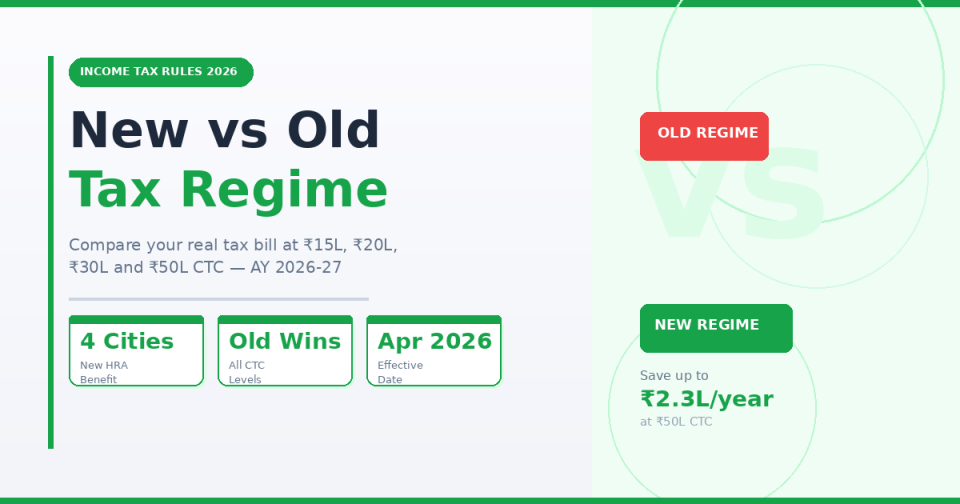
Higher HRA Benefits for More Cities: Four new cities — Hyderabad, Pune, Ahmedabad, and Bengaluru — now qualify for the higher 50% HRA exemption tier. Previously, only Delhi, Mumbai, Chennai, and Kolkata enjoyed this benefit.
Boosted Meal Card Exemptions: The tax exemption limit on meal cards has been increased, offering higher non-taxable perquisite income for employees who opt into these benefits.
Higher Children’s Education & Hostel Allowances: For those under the old tax regime, the exemption limits on children’s education and hostel expenditure allowances have been revised upward.
Revised Perquisite Rules: Key perquisites like company vehicles, interest-free or concessional loans, and festival/gift vouchers now carry revised and more favourable exemption structures.
Simplified ITR Filing: More taxpayers can now file ITR-1 or ITR-4, with eligibility expanded to include individuals owning up to two house properties (previously limited to one).
More Flexible LTC Rules: LTC exemptions are no longer capped at economy airfare. You can now claim based on the class of travel you are entitled to. For areas without public transport, a flat ₹30 per kilometre (shortest route) replaces the earlier AC first-class rail benchmark.
Salary Structure Used in This Comparison
| Component | ₹15L CTC | ₹20L CTC | ₹25L CTC | ₹30L CTC | ₹50L CTC |
|---|---|---|---|---|---|
| Basic Salary | ₹5,62,500 | ₹7,50,000 | ₹9,37,500 | ₹11,25,000 | ₹18,75,000 |
| Dearness Allowance | ₹1,87,500 | ₹2,50,000 | ₹3,12,500 | ₹3,75,000 | ₹6,25,000 |
| HRA Received | ₹3,90,000 | ₹5,20,000 | ₹6,50,000 | ₹7,80,000 | ₹11,00,000 |
| Actual Rent Paid | ₹3,75,000 | ₹5,00,000 | ₹5,00,000 | ₹6,30,000 | ₹16,00,000 |
HRA Exemption Calculation
HRA exemption is the lowest of: (1) Actual HRA received, (2) Rent paid minus 10% of salary, (3) 50% of salary for metro/newly added cities.
| Particulars | ₹15L | ₹20L | ₹25L | ₹30L | ₹50L |
|---|---|---|---|---|---|
| Actual HRA Received | ₹3,90,000 | ₹5,20,000 | ₹6,50,000 | ₹7,80,000 | ₹11,00,000 |
| Rent Paid – 10% of Salary | ₹3,00,000 | ₹4,00,000 | ₹3,75,000 | ₹4,80,000 | ₹13,50,000 |
| 50% of Salary | ₹3,75,000 | ₹5,00,000 | ₹6,25,000 | ₹7,50,000 | ₹12,50,000 |
| HRA Exemption Claimed | ₹3,00,000 | ₹4,00,000 | ₹3,75,000 | ₹4,80,000 | ₹11,00,000 |
Tax Comparison: ₹15 Lakh & ₹20 Lakh CTC
| Particulars | Old Regime (₹15L) | New Regime (₹15L) | Old Regime (₹20L) | New Regime (₹20L) |
|---|---|---|---|---|
| Basic Salary | ₹5,62,500 | ₹5,62,500 | ₹7,50,000 | ₹7,50,000 |
| Dearness Allowance | ₹1,87,500 | ₹1,87,500 | ₹2,50,000 | ₹2,50,000 |
| Other Salary Components | ₹7,50,000 | ₹7,50,000 | ₹10,00,000 | ₹10,00,000 |
| Gross Pay | ₹15,00,000 | ₹15,00,000 | ₹20,00,000 | ₹20,00,000 |
| Less: Standard Deduction | ₹50,000 | ₹75,000 | ₹50,000 | ₹75,000 |
| Less: HRA Exemption | ₹3,00,000 | — | ₹4,00,000 | — |
| Less: Food Coupons | ₹1,05,600 | ₹1,05,600 | ₹1,05,600 | ₹1,05,600 |
| Less: Children’s Education Allowance | ₹72,000 | — | ₹72,000 | — |
| Less: Hostel Expenditure Allowance | ₹2,16,000 | — | ₹2,16,000 | — |
| Taxable Salary | ₹7,56,400 | ₹13,19,400 | ₹11,56,400 | ₹18,19,400 |
| Less: 80C Deductions | ₹1,50,000 | — | ₹1,50,000 | — |
| Less: Employer NPS (80CCD(2)) | ₹75,000 | ₹1,05,000 | ₹1,00,000 | ₹1,40,000 |
| Less: Own NPS (80CCD(1B)) | ₹50,000 | — | ₹50,000 | — |
| Less: Health Insurance (80D) | ₹50,000 | — | ₹50,000 | — |
| Net Taxable Income | ₹4,31,400 | ₹12,14,400 | ₹8,06,400 | ₹16,79,400 |
| Total Tax Liability | NIL | ₹14,980 | ₹76,730 | ₹1,41,320 |
✅ At ₹15L CTC — Old regime wins: Zero tax vs ₹14,980 under new regime.
✅ At ₹20L CTC — Old regime wins: ₹76,730 vs ₹1,41,320. Savings of nearly ₹65,000.
Tax Comparison: ₹25L, ₹30L & ₹50L CTC
| Particulars | Old (₹25L) | New (₹25L) | Old (₹30L) | New (₹30L) | Old (₹50L) | New (₹50L) |
|---|---|---|---|---|---|---|
| Basic + DA | ₹12,50,000 | ₹12,50,000 | ₹15,00,000 | ₹15,00,000 | ₹25,00,000 | ₹25,00,000 |
| Other Components | ₹12,50,000 | ₹12,50,000 | ₹15,00,000 | ₹15,00,000 | ₹25,00,000 | ₹25,00,000 |
| Gross Pay | ₹25,00,000 | ₹25,00,000 | ₹30,00,000 | ₹30,00,000 | ₹50,00,000 | ₹50,00,000 |
| Less: Standard Deduction | ₹50,000 | ₹75,000 | ₹50,000 | ₹75,000 | ₹50,000 | ₹75,000 |
| Less: HRA | ₹3,75,000 | — | ₹4,80,000 | — | ₹11,00,000 | — |
| Less: Food Coupons | ₹1,05,600 | ₹1,05,600 | ₹1,05,600 | ₹1,05,600 | ₹1,05,600 | ₹1,05,600 |
| Less: Children’s + Hostel | ₹2,88,000 | — | ₹2,88,000 | — | ₹2,88,000 | — |
| Taxable Salary | ₹16,81,400 | ₹23,19,400 | ₹20,76,400 | ₹28,19,400 | ₹34,56,400 | ₹48,19,400 |
| Less: 80C | ₹1,50,000 | — | ₹1,50,000 | — | ₹1,50,000 | — |
| Less: Employer NPS | ₹1,25,000 | ₹1,75,000 | ₹1,50,000 | ₹2,10,000 | ₹2,50,000 | ₹3,50,000 |
| Less: Own NPS + Health Ins. | ₹1,00,000 | — | ₹1,00,000 | — | ₹1,00,000 | — |
| Net Taxable Income | ₹13,06,400 | ₹21,44,400 | ₹16,76,400 | ₹26,09,400 | ₹29,56,400 | ₹44,69,400 |
| Total Tax Liability | ₹2,12,600 | ₹2,45,540 | ₹3,28,040 | ₹3,77,330 | ₹7,27,400 | ₹9,57,650 |
✅ At ₹25L CTC — Old regime saves ₹32,940.
✅ At ₹30L CTC — Old regime saves ₹49,290.
✅ At ₹50L CTC — Old regime saves ₹2,30,250 — a significant annual advantage.
Which Regime Should You Choose?
Based on the above analysis, the old tax regime consistently delivers lower tax liability when salary components are optimally structured — especially if you’re actively claiming HRA, NPS, health insurance, 80C investments, and children’s education allowances.
The new tax regime is simpler — fewer exemptions to track, lower compliance burden — and may suit individuals who don’t have significant deductions to claim or who prefer a hassle-free approach. But if you’re disciplined about financial planning and invest in PPF, ELSS, NPS, and health insurance, the old regime offers a clear edge at every CTC level.
Other Notable Changes in Income Tax Rules, 2026
Expanded ITR-1 and ITR-4 Eligibility: You can now file the simplified ITR-1 or ITR-4 if you own up to two house properties (earlier restricted to one). This brings a larger pool of salaried individuals under the simplified filing framework.
ITR-4 Restriction on Certain Deductions: Taxpayers cannot file ITR-4 if they claim deductions under ‘Income from Other Sources’ via Section 93 (except family pension). This keeps ITR-4 limited to straightforward income structures.
Flexible LTC Exemptions: The old economy-airfare cap on Leave Travel Concession is gone. You can now claim based on your entitled travel class. For routes without public transport, a flat ₹30 per kilometre (shortest route) applies — bringing clarity and uniformity.
💡 Key Takeaway: The 2026 tax rules don’t change rates — they change what’s taxable. With expanded HRA benefits for more cities, higher allowance exemptions, and revised perquisite rules, smart salary structuring under the old regime can deliver meaningful savings across all income levels. Run the numbers for your specific structure before choosing — and file your ITR by July 31, 2027.
Disclaimer: This blog is for general informational purposes only and does not constitute tax or financial advice. Tax liability varies based on individual circumstances. Please consult a qualified tax advisor for personalised guidance.
