
If you’ve ever wondered where all that imported jewellery in Indian stores comes from — well, the rules around that just changed. Big time.
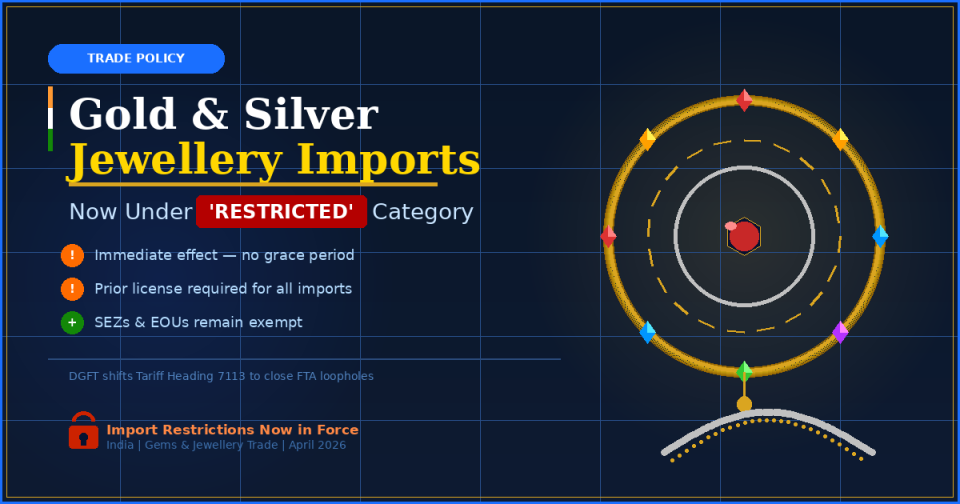
The Indian government has quietly made a move that’s sending ripples through the gems and jewellery trade: importing gold, silver, and platinum jewellery into India is no longer a simple, open process. As of this week, it’s now in the “Restricted” category — which basically means you need special government permission before a single piece crosses the border.
What Changed, Exactly?
Until now, jewellery falling under a specific customs category (Tariff Heading 7113, for those who like the details) could be imported fairly freely. That’s over. The Directorate General of Foreign Trade (DGFT) — the government body that oversees India’s import-export rules — has officially put a stop to that.
From now on, traders need prior approval or a proper license to bring in any gold, silver, or platinum jewellery. No approval? No entry.
And There’s No Grace Period
Here’s the part that’s really rattled the industry: this happened overnight, with zero warning time.
No “you have 30 days to adjust.” No exceptions for deals that were already in progress. If you signed a contract last week, made your payments, and your shipment is already sailing toward India — tough luck. The moment it arrives at an Indian port, the new rules apply.
The DGFT has been crystal clear: there are no transitional relaxations. It kicks in immediately, for everyone.
So Why Did the Government Do This?
The short answer: loopholes were being exploited.
India has Free Trade Agreements (FTAs) with several countries, including a major one with ASEAN nations (think Thailand, Malaysia, Vietnam, etc.). These agreements allow certain goods to come in at lower import duties.
Some traders figured out a workaround — they’d route raw gold or silver through these countries, have it made into jewellery there, and then import it as “jewellery” under the FTA. This let them dodge the higher duties that would normally apply to precious metals. Smart? Sure. But it was costing the government a lot of money in lost revenue.
By shifting jewellery imports to the “Restricted” list, that shortcut is effectively shut down.
Who Is Exempt?
Not everyone is affected equally. If you’re operating in a Special Economic Zone (SEZ) or running a 100% Export Oriented Unit (EOU), you’re in the clear — you can carry on as usual. Businesses that import jewellery as part of government-approved export schemes in the gems and jewellery sector are also exempt.
The common thread? These are all businesses focused on exports, not selling within India. The crackdown is aimed squarely at domestic misuse, not at hurting India’s already-thriving jewellery export industry.
What Does This Mean for You?
If you’re a regular consumer buying jewellery in India, you might not feel this immediately. But over time, if imported jewellery becomes harder to source, prices could inch up — especially for designs that are typically manufactured abroad.
For traders and small business owners in the jewellery space, the concern right now is bureaucratic delays. Getting licenses and approvals takes time, and if the system isn’t efficient, even honest businesses could find themselves stuck waiting while shelves go empty.
The government’s move makes sense on paper. Whether it plays out smoothly in practice is the real question — and the industry is watching very closely.
