
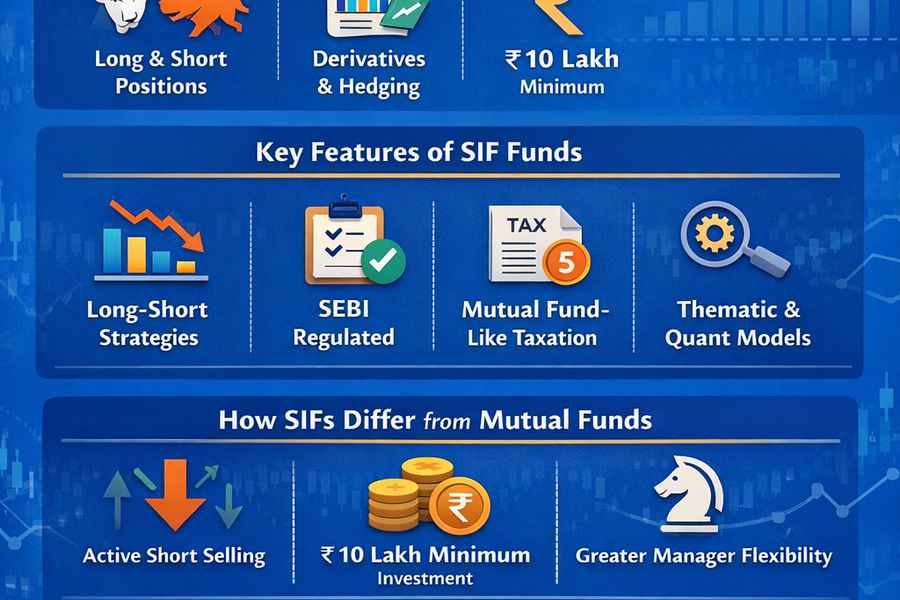
India’s investment landscape is evolving fast, and SIF Funds (Specialized Investment Funds) are one of the biggest additions introduced by SEBI in 2025. These funds are designed to fill the gap between traditional mutual funds and Portfolio Management Services (PMS) by allowing greater flexibility in strategy—while still operating under a regulated mutual fund-style framework.
For investors who want more than simple “buy and hold” portfolios, SIF funds offer a way to access advanced investing styles like long-short strategies, derivatives-based hedging, and thematic models, without moving fully into PMS or Alternative Investment Funds (AIFs).
What Are SIF Funds?
Specialized Investment Funds (SIFs) are a newly introduced investment category that allows fund managers to use more dynamic portfolio strategies compared to regular mutual funds.
Unlike traditional mutual funds, which mainly generate returns through long-only exposure to equities or bonds, SIF funds can combine:
- Long positions (buying stocks expected to rise)
- Short positions (profiting from falling stocks)
- Derivative tools for hedging and risk management
These funds are designed for more experienced investors, with a minimum investment requirement of ₹10 lakh.
Why SEBI Introduced SIF Funds in 2025
SEBI created SIFs to provide investors access to more sophisticated, professionally managed strategies—without removing the transparency and structure that investors get from mutual funds.
The goal is simple:
✅ Give fund managers more tools to manage volatility
✅ Offer better risk-adjusted returns across different market cycles
✅ Create an option between retail mutual funds and high-entry PMS products
Key Features of SIF Funds
1. Strategic Flexibility with Derivatives
One of the biggest advantages of SIF funds is the ability to use derivatives actively.
Fund managers can:
- Hedge portfolios during uncertain markets
- Reduce downside risk through hedged strategies
- Take up to 25% unhedged short exposure, meaning the portfolio can profit even if certain stocks fall
📌 Example:
If the overall market is weak, the fund may keep long exposure in strong sectors and short weaker stocks to reduce risk.
2. Designed for High-Net-Worth Investors (HNI Focused)
SIF funds are not meant for small-ticket investments.
✅ Minimum investment: ₹10 lakh
This makes them ideal for:
- HNIs exploring advanced strategies
- Investors moving beyond basic MF categories
- People who want strategy-driven portfolios without full PMS involvement
3. SEBI-Regulated Structure (Transparency & Oversight)
A major strength of SIFs is that they operate within SEBI-defined categories, ensuring:
- Better transparency compared to many unregulated products
- Standardized reporting
- Strong compliance framework similar to mutual funds
This provides investors confidence that the product is structured, monitored, and regulated.
4. Mutual Fund-Like Taxation Benefits
In many cases, SIF funds follow mutual fund taxation rules, which can be more favorable when compared to structures like PMS or other alternatives.
📌 Note: Tax treatment can vary depending on the fund’s nature and strategy, so investors should always check the scheme structure and consult a tax advisor.
5. Multiple Strategy Options Available
SIFs allow fund houses to launch funds based on a wider range of investment approaches such as:
- Equity Long-Short Strategy
- Thematic Strategies (sector-based or trend-driven)
- Quantitative / Algorithmic Models
- High Conviction Portfolios
- Dynamic Asset Allocation Strategies
This opens up portfolios that can be built for different market conditions rather than only rising markets.
How SIF Funds Are Different from Traditional Mutual Funds
SIFs are often compared with mutual funds—but the strategy freedom makes them very different.
✅ 1. Active Shorting Allowed
Traditional mutual funds mostly remain long-only and use derivatives mainly for hedging.
SIF funds can take short positions as part of the return strategy, which adds a new dimension to portfolio construction.
✅ 2. Higher Minimum Investment
Regular mutual funds can be started with SIPs as low as ₹500–₹1,000.
SIFs require ₹10 lakh, positioning them for investors who can handle a longer horizon, higher volatility, and strategy-based risk.
✅ 3. More Manager Freedom
Mutual fund strategies are often limited to standard categories like large-cap, flexi-cap, balanced advantage, etc.
SIF managers can build portfolios using more complex combinations, including:
- Hedged exposure
- Tactical calls
- Volatility management
- Factor-based positioning
Who Should Consider Investing in SIF Funds?
SIF funds are not meant for everyone. They are better suited for investors who:
✅ Want advanced investing options beyond traditional funds
✅ Understand higher risk and more complex strategies
✅ Prefer professional strategy execution rather than DIY trading
✅ Are comfortable with a larger investment amount (₹10 lakh+)
✅ Want exposure to strategies designed for multiple market cycles
Who Should Avoid SIF Funds?
SIFs may not be suitable for investors who:
❌ Are new to mutual funds
❌ Prefer simple, low-volatility long-only investing
❌ Want short-term returns
❌ Don’t understand derivatives-based strategies
❌ Cannot tolerate drawdowns or strategy underperformance
Final Thoughts: Are SIF Funds Worth Exploring?
SIF funds are a major step forward in India’s investment ecosystem. They offer the regulated structure of mutual funds combined with a more powerful strategic toolkit that was traditionally available mainly through PMS or AIF products.
For investors looking to diversify beyond plain equity or debt mutual funds, SIFs can provide a unique opportunity—especially for those aiming for better downside control and more consistent outcomes across market cycles.
If used correctly and aligned with risk appetite, SIF funds can become a strong portfolio enhancer for experienced long-term investors.
