
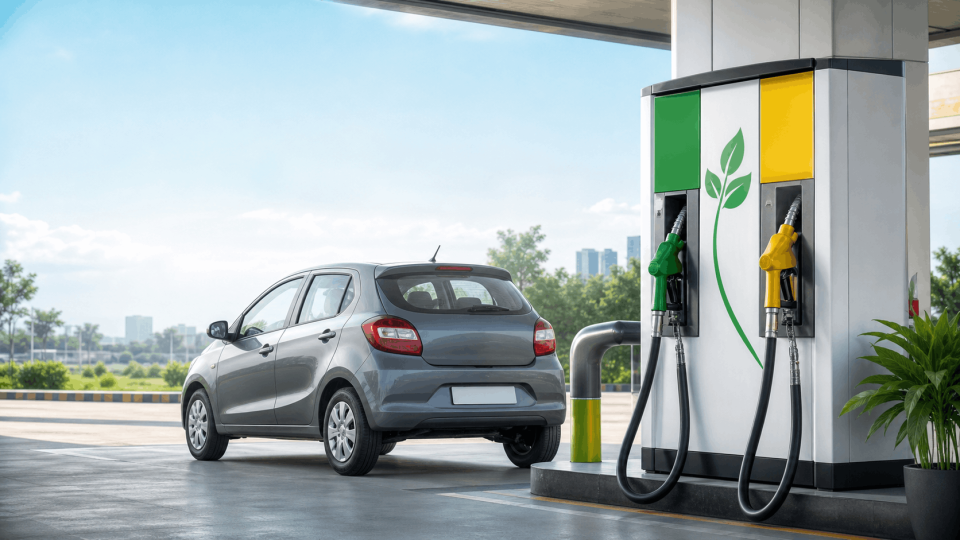
Short answer: nothing changes for ordinary E20 cars at the pump, except that owners need to be more careful about choosing the right nozzle. An E20 vehicle is built to handle petrol with up to 20% ethanol. E85 is a much stronger ethanol blend and should be used only in a certified flex-fuel vehicle.
India’s ethanol journey has moved quickly. E20 petrol is now the mainstream reference point, flex-fuel two-wheelers are entering the market, and the first flex-fuel car announcements have made E85 and E100 part of everyday motoring conversations. That naturally raises one practical question: if my car can run on E20, can it also run on E85?
The answer is no. E20 compatibility is not the same thing as flex-fuel compatibility.
Key takeaways
- E20 cars should not use E85. E85 contains far more ethanol than an E20 fuel system and engine calibration are designed for.
- Flex-fuel vehicles are different. They use ethanol-resistant parts and engine controls that can adjust to high-ethanol blends.
- Do not rely on model name alone. Check the owner’s manual, fuel-filler label, manufacturer website, or dealer confirmation before using any blend above E20.
- The rollout is still early. E85 and E100 availability will matter most for vehicles that are factory-certified for flex fuel.
What E20 means
E20 is petrol blended with 20% ethanol and 80% petrol. Vehicles sold as E20-ready are designed with materials, seals, hoses, pumps, injectors and engine calibration suitable for that ethanol level.
For many Indian vehicle owners, E20 is not a special fuel choice anymore; it is becoming the regular petrol experience. But E20-readiness has a boundary. It tells you the vehicle can handle up to 20% ethanol. It does not tell you the vehicle can handle 85% ethanol.
What E85 means
E85 is a high-ethanol fuel for flex-fuel vehicles. Internationally, the term E85 usually covers a range rather than a single fixed number: the ethanol content can vary by geography and season, but it is still dramatically higher than E20. That higher ethanol share changes how the fuel behaves inside the vehicle.
Ethanol is more oxygen-rich and has lower energy per litre than petrol. A vehicle running high-ethanol fuel needs to inject more fuel, adjust timing and manage cold starts differently. It also needs fuel-system parts that can tolerate the chemical properties of ethanol over the long term.
Why an E20 car cannot safely use E85
An E20 car may start and run briefly if E85 is accidentally filled, but that does not make it safe. The risk is that the engine control unit, fuel pump, injectors and rubber or plastic fuel-system parts may not be designed for that blend.
The most common problems can include hard starting, rough running, poor acceleration, warning lights, lower mileage, overheating of some components, fuel-pump stress and long-term corrosion or seal damage. The exact outcome depends on the vehicle, how much E85 was added, how much E20 petrol was already in the tank, and how long the vehicle is driven after the mistake.
If a non-flex-fuel car is misfuelled with E85, the safest move is simple: do not drive it further than necessary. Contact the manufacturer roadside line, authorised workshop or fuel-station manager and ask about draining and inspection. A small splash mixed into a nearly full tank is a different situation from a full tank of E85, but both should be treated carefully.
How flex-fuel vehicles are different
Flex-fuel vehicles are engineered for a wider ethanol range. Depending on the market and model, an FFV may be able to run on petrol, E20, E85, or even E100. The difference is not just a badge. It is a combination of hardware and software.
- Ethanol-resistant fuel lines, seals, gaskets and tank materials
- Fuel pumps and injectors sized for higher fuel flow
- Engine software that adjusts fuel injection and ignition timing
- Sensors or control strategies that detect the ethanol blend in the tank
- Cold-start and emissions controls suited to high-ethanol operation
That is why the owner’s manual matters more than the pump label. A flex-fuel vehicle gives the engine permission to adapt. A normal E20 vehicle does not.
What is happening in India now?
The Indian market is moving from E20 compatibility toward a small but visible flex-fuel ecosystem. Recent launches and announcements have included flex-fuel motorcycles such as Hero’s Splendor+ Flex Fuel and HF Deluxe Flex Fuel, along with Suzuki’s Gixxer SF 250 FFV in the high-ethanol motorcycle space. Maruti Suzuki’s WagonR flex-fuel car has also been presented as a major step for passenger vehicles.
Fuel infrastructure is expected to expand too. Public reports quoting Union Petroleum Minister Hardeep Singh Puri have referred to around 500 ethanol dispensing stations by December 2026 and a target of 5,000 by 2027. The important detail is that this infrastructure is meant to support flex-fuel adoption; it does not turn existing E20-only vehicles into E85 vehicles.
What E20 car owners should do
If your car or bike is E20-ready but not flex-fuel certified, continue using the regular petrol grade specified for the vehicle. At stations that offer multiple ethanol blends, read the pump label before filling. If in doubt, ask the attendant and check the vehicle’s fuel-filler cap or manual.
Owners of older vehicles should be even more cautious. Some older models were designed before E20 became the policy direction, and their material compatibility may vary. For those vehicles, manufacturer guidance is more useful than social-media advice.
Will E85 save money?
Per-litre price is only one part of the equation. High-ethanol fuel usually contains less energy per litre than petrol, so a flex-fuel vehicle may travel fewer kilometres per litre on E85 than on petrol. Whether it saves money depends on the price gap, vehicle efficiency and driving conditions.
For non-flex-fuel cars, the calculation is easier: there is no saving worth risking the fuel system, warranty position or reliability of the vehicle.
The bottom line
E85 arriving in India is good news for the flex-fuel roadmap, farmers supplying ethanol feedstock, and future vehicles designed around higher ethanol blends. But for today’s E20 cars, it is not an upgrade fuel.
Think of E20 and E85 as different compatibility classes. If your vehicle clearly says flex fuel, follow the manufacturer’s instructions. If it only says E20, stay with E20 petrol and leave E85 for vehicles built to use it.
